Brainstorm:
The brainstorming process was a difficult one, as it was hard to come up with positive aspects of language barriers, and sometimes it was difficult to come up with unique problems. To fix this, we asked around for other ideas, and then built off of those ideas.
Top 5 Problems:
- Makes Communication more difficult. 2. Less access to work for NES (Non-English speakers). 3. NES have a disadvantage on standardized tests. 4. Difficulty in navigation 4. NES are more likely to be taken advantage of in legal situations 5. Causes communication errors between patients and practitioners.
Top 5 Positives:
- Preserves cultural diversity. 2. People can bond through learning each other’s languages 3. Helps some people earn jobs (interpreters, etc.) 4. More interest in being multilingual 5. Forces people to respect other cultures
Population: Non-English speakers, monolingual English speakers, and people who don’t speak English as their primary language.
Copy of Survey
Survey: The survey was conducted through asking people to take it through various social media posts. Most people who responded were either Lindblom students or former ones. There were 20 questions, and around 40 people responded to the survey.
Spreadsheet Link: https://docs.google.com/spreadsheets/d/1K31-FkrK79BgT6c0uu8Yc88TjfcdeoBhPX4E1l2DS9Q/edit#gid=597755485
Language Barriers Survey
Are you multilingual?Are you interested in learning another language?
No A little Neutral Some Yes
Do you think non English speakers have enough resources in today’s climate?
No A little Neutral Some Yes
Do you know people who speak multiple languages?
No A little Neutral Some Yes
Do you think public transportation is convenient for non English speakers?
No A little Neutral Some Yes
Do you think communication would be easier if there were more multilingual people?
No A little Neutral Some Yes
Do you have trouble ordering at restaurants that don’t specialize in your language?
No A little Neutral Some Yes
Do you think it’s easy for non English speakers to find jobs?
No A little Neutral Some Yes
Do you think schooling is harder for non English speakers?
No A little Neutral Some Yes
Do you believe non English speakers have a disadvantage on standardized tests?
No A little Neutral Some Yes
Does your family speak multiple languages?
No A little Neutral Some Yes
Would you be willing to learn another language?
No A little Neutral Some Yes
Do you feel uncomfortable when others speak a language different than your own?
No A little Neutral Some Yes
Do you think multilingual people feel comfortable in this environment?
No A little Neutral Some Yes
Do you think language barriers are a problem in society?
Do you have trouble traveling around the city?
Yes No A little
Did you have trouble learning English?
Yes No A little
Did you have trouble buying food, drink, etc?
Yes No A little
Is there anything that you think would make navigating the neighborhood as a non-English speaker easier?
Charts:
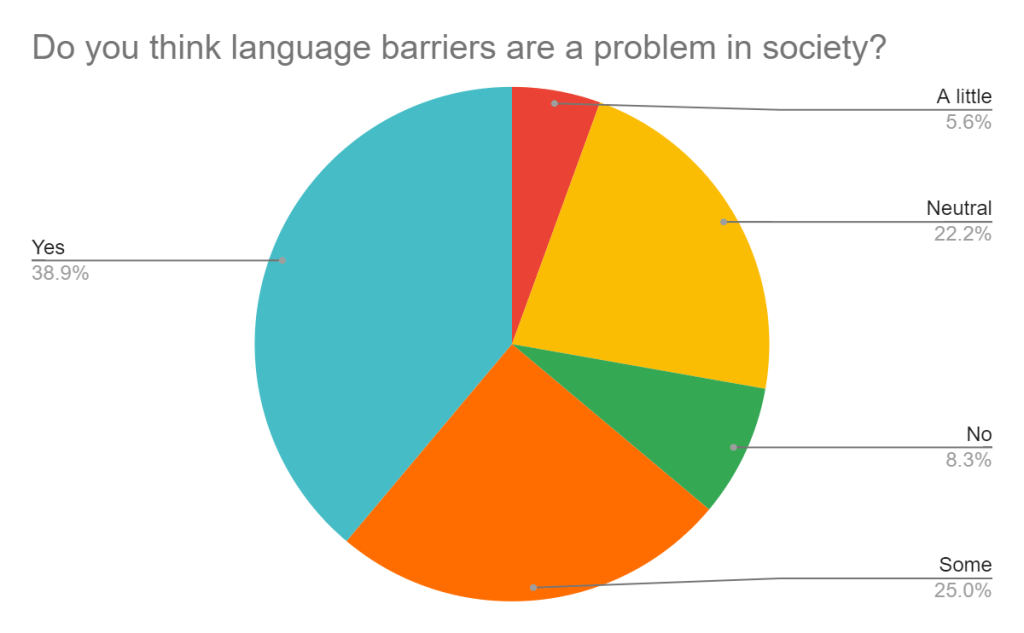

Graph 1: 69.5% of the people who were surveyed thought that language barriers were at least a small problem, while 30.5% were neutral, or thought they weren’t a problem.
Graph 2: 38.2% were neutral on the issue of public transportation for non-English speakers, 35.4% thought it was at least a small problem, and 26.5% thought it wasn’t a problem at all.
Interpretation of Data: A lot of the people who were surveyed seemed apathetic to the problem of language barriers, or thought they weren’t a problem at all. This could be due to the fact that everyone who was surveyed currently attends or has attended Lindblom, where most people are native English speakers, or can at least speak English fluently.
I also learned that despite Lindblom containing a high amount of native English speakers, there were still some people who seemed to struggle with language barriers. For example, 15.2% of those who were surveyed had trouble buying, food, drink, etc. due to language barriers. Although it’s not a large percentage, it shows that even though Lindblom is a predominantly English speaking school, there are still some kids who may need support.
Interviews:
Interview 1: Mother of Ashley Young. She said that she thought language barriers were a problem in society, primarily because people earn less respect when they don’t speak English, and often have a harder time finding work.
Interview 2: Uncle of Ashley Young. He thought that language barriers were a problem, because people often get hostile and uncomfortable when others speak different languages, for example, his mother. He also thinks that they cause hostility between people in general.
Interview 3: Chloe Kelly (Lindblom student): I asked her how she thought language barriers affect other people. She thought that language barriers were a problem, because they hindered communications between people, and she thinks communication is essential for people to live.
Interesting things:
- My grandmother apparently always complained when there were people speaking Spanish around her.
- My mom thinks that language barriers end up causing less respect between people, rather than simple miscommunication.
Research Articles
Ashley Young
Article #1: https://bmchealthservres.biomedcentral.com/articles/10.1186/s12913-015-1024-8
Summary #1: The rising cultural heterogeneity of patients and practitioners causes communication in the healthcare sector to become less effective. Effects of language barriers between patients and practitioners include (but are not limited to) patients failing to comply with instructions, or the patients failing to communicate what they are feeling, or specific symptoms. Patients rated the quality of their conversations, and the quality was lessened when they both spoke a different primary language. In some cases, an interpreter was present, which may have raised the effectiveness of communication.
Ashley Young
Article #2: https://www.businesstopia.net/communication/language-barriers
Summary #2: Language barriers exist even in situations where the same language is being spoken. The most potent form of a language barrier is when two people speak different languages, as the communication is completely ineffective. Language barriers also exist between people from different regions, due to differences in accents, slang, jargon, etc. They also exist between people of different personalities and education levels. Some people may use broken grammar, or have a soft voice, while others may use the opposite. This can create some difficulty when it comes to understanding each other, although the communication is likely to be somewhat effective, if they are speaking the same language.
Nayali Guzman
Article #3: https://journalofethics.ama-assn.org/article/language-barriers-and-patient-encounter/2007-08
Summary #3: In essence, the article touches on how listening to the difficulty of patients in hospitals who face a language barrier with staff, and in particular studied translated text from English into Spanish, there are three factors inherent in language-discordant communication that establish it as so: (1) language and culture are inextricably linked; (2) relationship building is disrupted by interpreter-mediated communication; and (3) cultural competency and effective communication are interdependent.
 Lindblom Computer Science Project, 2nd Pd.